
Hygienic food industry doors
Hygienic door systems designed for meat plants, dairy facilities and food processing zones. Pore-free, washable, chemical-resistant structures with uncompromised food safety.
Where the door is a critical element of audits and production safety
In strictly regulated food industry environments, a door is not merely a separating element but an integral part of quality assurance systems such as HACCP, IFS and BRC. Surfaces must withstand constant moisture, alkaline or acidic disinfectants, while preventing cross-contamination.
Compromised material selection and poor edge design can quickly become an audit risk: bacteria and biofilms settling in difficult-to-clean gaps or on corroding components represent a direct food safety hazard.
A professional food industry door is manufactured with closed, gap-free flush welds, deep-drawn frame systems and water-shedding profiles. It contains no protruding fasteners or uncovered cavities where wash water could remain.
Transitions between hygiene zones, such as raw meat preparation and finished product packaging, require strict material quality. The lactic acid environment of a dairy plant or the salty air of a fish processing facility quickly attacks standard steel; in such cases only acid-resistant WNr. 1.4404 provides a durable solution.
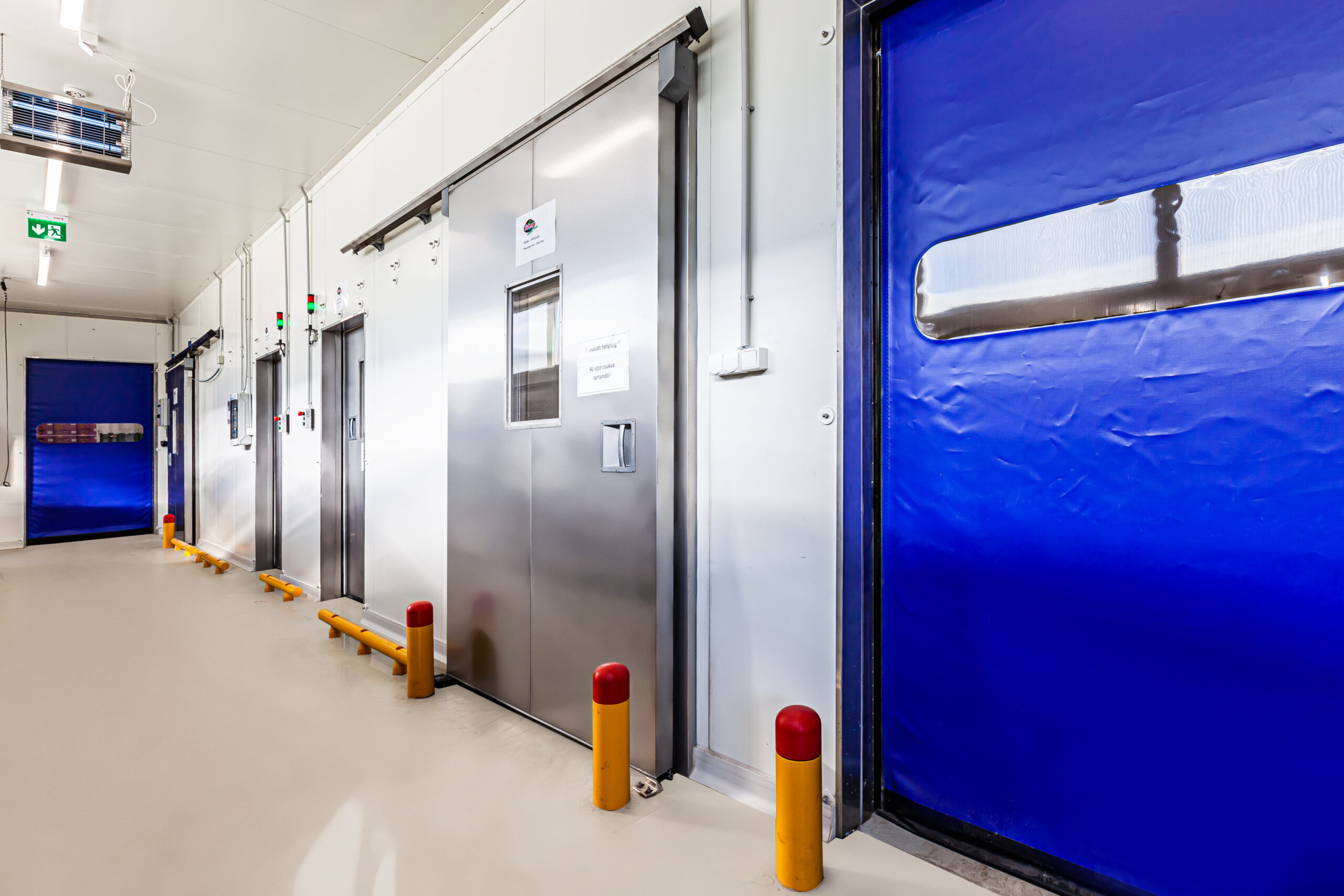
Technical details for microbiological safety
Gap-free flush surface design
Smooth, pore-free stainless steel surfaces, flush-mounted vision windows and closed edges that help prevent bacteria and mould from settling, while speeding up disinfection.
Exposure-specific stainless steel grade
For general areas we use WNr. 1.4301 stainless steel, while for processes with high salt, chlorine or lactic acid exposure we integrate the more acid-resistant WNr. 1.4404 alloy.
Chemical-resistant industrial hardware
Closed-housing, lubrication-free stainless steel hinges and lock mechanisms. We avoid conventional steel screws or lubricants that could contaminate the production process.
Construction adapted to the production technology
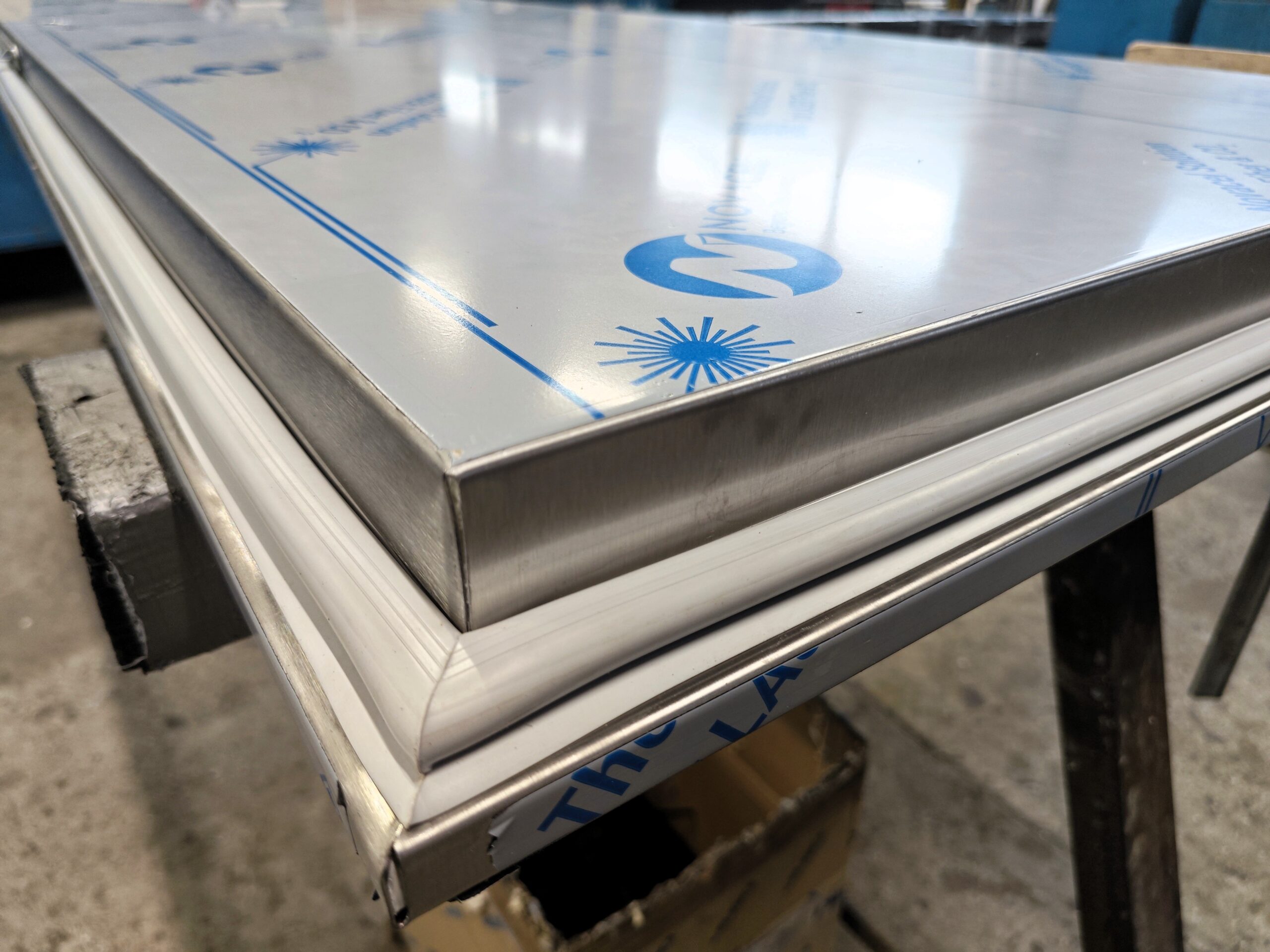
Water-resistant core and seals
Door leaves are filled with closed-cell polyurethane (PUR) foam that does not absorb moisture. The door frame is sealed hermetically with food-safe FDA-grade silicone or EPDM seals.

Liquid-draining geometry
The stainless steel frame structure is designed according to the receiving wall type and dimensions, based on customer requirements, using a water-shedding design that allows wash water to drain away.
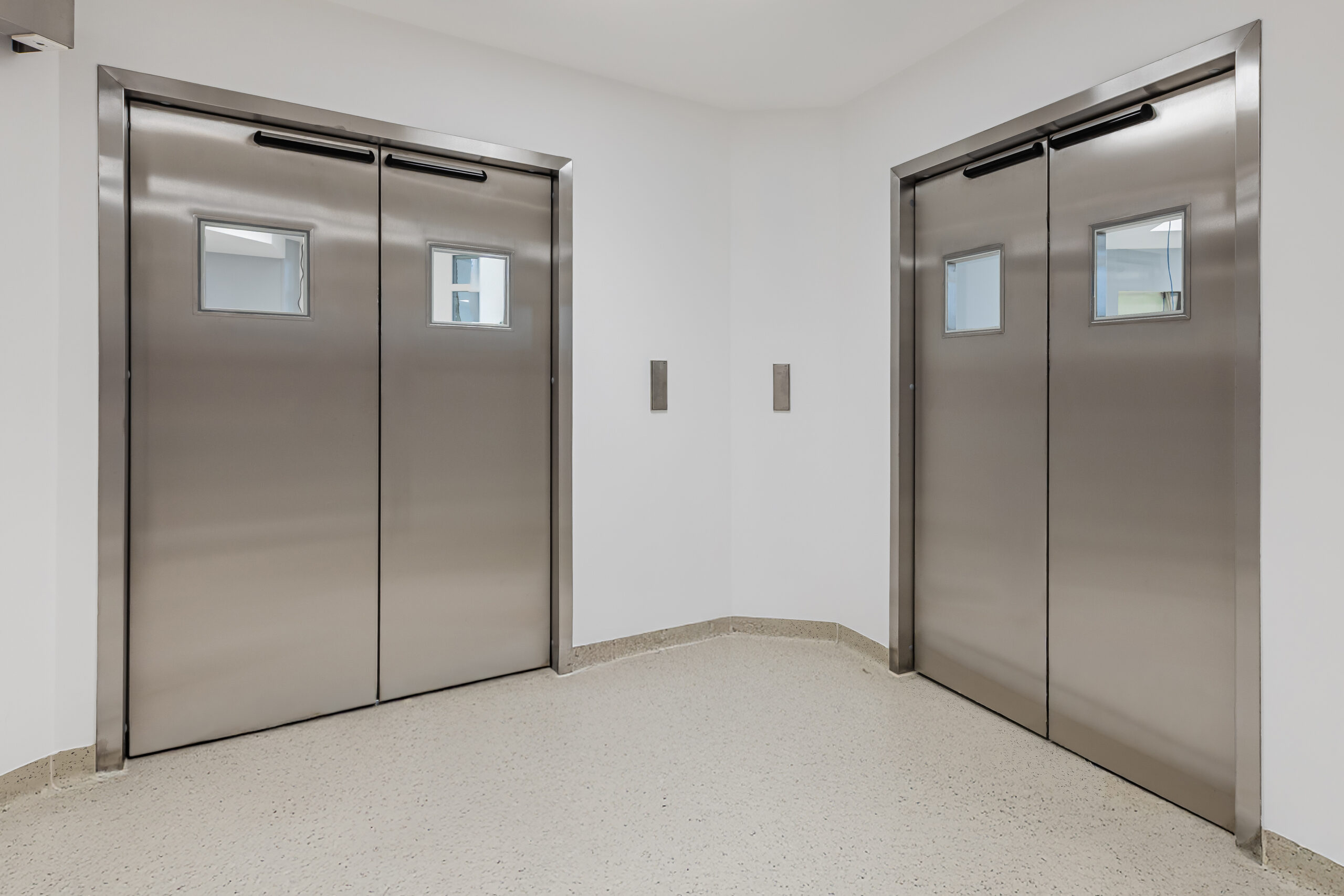
Touch-free passage
To avoid physical contact and prevent recontamination after handwashing, systems can be equipped with elbow switches or radar-controlled automation.
Technical and material quality parameters
Every door is custom-made with a frame solution suitable for the customer's sandwich panel or masonry wall thickness.
| Frame design | The stainless steel frame structure is designed according to the receiving wall type and dimensions, based on customer requirements. |
| Surface | Brushed finish to reduce glare and conceal micro-scratches and fingerprints. |
| Insulating core | High-density, water-resistant, freon-free polyurethane foam, typically 33+ kg/m³. |
| Hardware and hinges | 2D or 3D adjustable, lubrication-free industrial hardware with concealed fastening. |
| Operating options | Manual opening, swing-door execution or heavy-duty automatic operation. |
Where are stainless steel food industry doors essential?
Any area where open food, biological raw materials or aggressive cleaning agents are present immediately excludes painted steel or wooden doors. Stainless steel systems are essential in the following facilities:
Where high blood, salt and protein content, together with alkaline washdowns, create extreme corrosion load on doors. WNr. 1.4404 material is recommended.
Due to lactic acid and special maturation climate with high humidity, washable surfaces that resist fungal growth are critical.
To reduce risks from fine airborne dust such as flour and sugar, and to support the hermetic separation of allergen zones.
Sterile zones before finished product packaging, where maintaining positive pressure and excluding cross-drafts are key objectives.
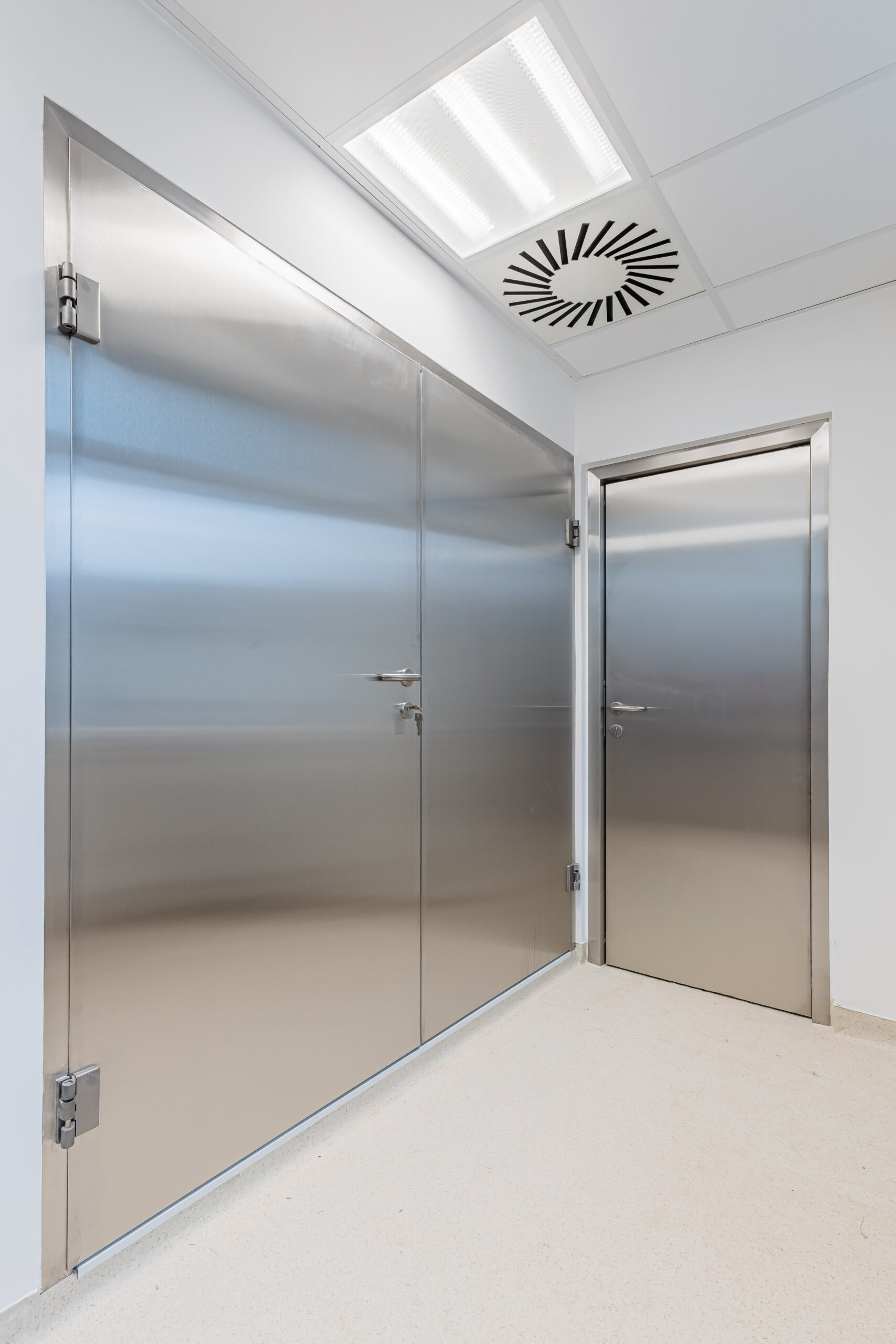
Precision manufacturing and installation process
Technology assessment
We assess cleaning protocol, chemical exposure and traffic intensity to select the optimal stainless steel grade, WNr. 1.4301 or WNr. 1.4404.
Design and specification
We develop wall connection details and define hygienic thresholds, windows and washable automation options.
Custom stainless steel manufacturing
Door leaves and frames are manufactured in our Hungarian facility with laser cutting and closed, post-treated welds.
Installation and validation
Professional installation into sandwich panels or masonry, with gap-free sealing that ensures immediate washability.
Technical answers before planning starts
When is acid-resistant WNr. 1.4404 required instead of general WNr. 1.4301 stainless steel?
When chloride ion concentration is high in the process area, such as in salting rooms or fish processing, when lactic acid is present in dairy or cheese production, or when aggressive alkaline-acid foam cleaning is used daily. WNr. 1.4301 may suffer pitting corrosion in such environments.
Can the door be retrofitted onto an existing sandwich panel wall?
Yes. Our frame systems can be made with C-shaped, outer-wall-plane connection solutions that are easily fixed onto existing 40–200 mm thick panels while preserving air tightness.
Do these doors meet BRC and IFS food safety standards?
Yes. Gap-free welds, food-grade FDA seals, sloped water-shedding edge designs and lubrication-free hardware all support the requirements of strict international quality assurance audits.
How can forklift traffic and hygiene be handled at the same time?
For high-traffic zones, food industry doors can be fitted with lower PE-HD impact protection strips, or we recommend hybrid solutions such as hygienic washable industrial swing doors and automatic radar switches.
Case studies and hygiene guidelines
There are currently no articles in this category.
Queried category: knowledge-base | Post type: post
Secure your facility hygiene with uncompromised industrial doors.
Send us the planned opening dimensions, wall structure type and cleaning procedures typical for your industry. Our engineers help specify an audit-safe, durable steel grade and door structure perfectly matched to your production technology.